
How should we care for a child's facial stitches so the scar stays minimal?
To minimize a scar after a child's facial stitches, continue scar ointment, silicone gel, and sun protection for 2–3 months after stitch removal and follow progress. Myongji Best Plastic Surgery Clinic in Myeongji-dong, Busan explains when scar laser can start, how long redness lasts, and what research shows.
Quick answer
After stitch removal, apply scar ointment twice a day for 2–3 months, keep up sun protection whenever the child goes out, and watch whether the suture line turns red and firm. At Myongji Best Plastic Surgery Clinic, scar laser is considered from 1–2 months after stitch removal, based on wound location, redness, scar thickness, and recovery. No scar can be removed completely, but most scars fade over time, and that can take up to 2 years.
Why it matters now
It is easy to assume scar care ends with suturing, but a scar's thickness and color keep changing for months after the stitches come out, and moisturizing, protection, and sun protection during that time affect the result. Children find it hard to keep up sun protection and avoid scratching on their own, so caregivers need to know the order and duration of care.
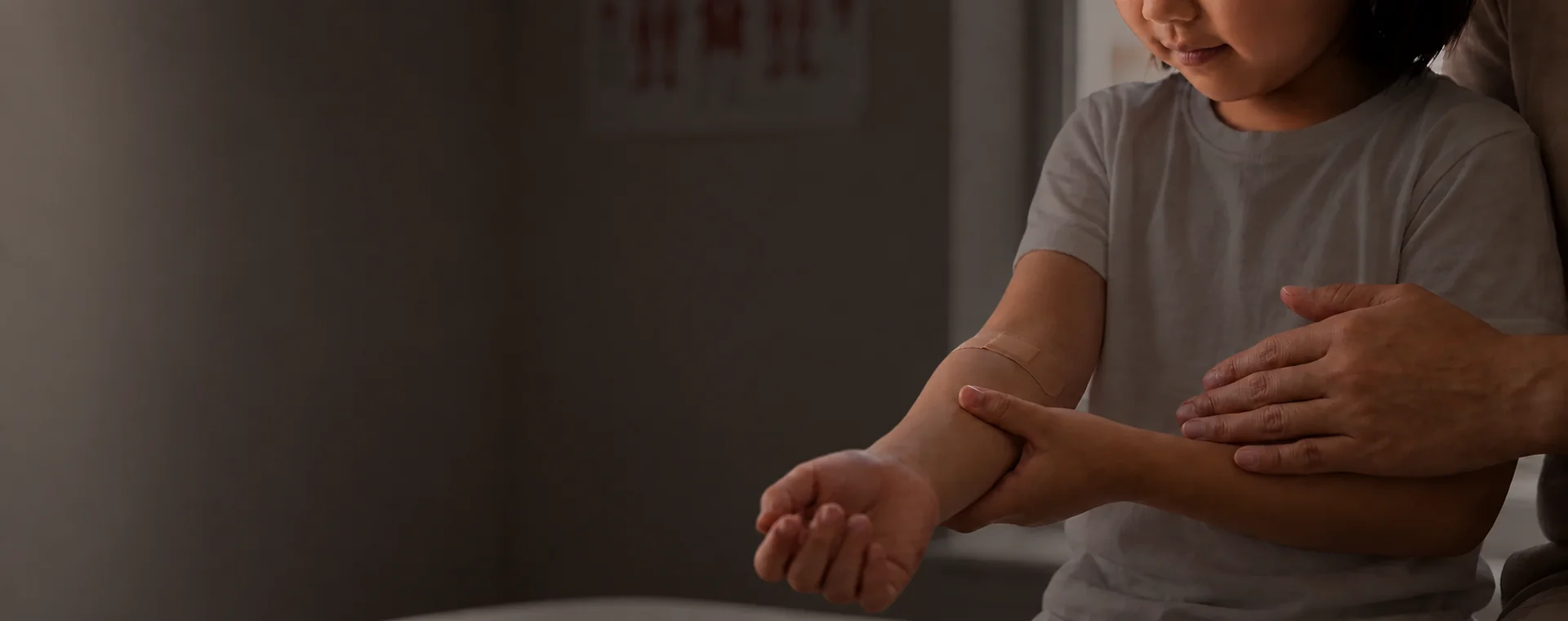
What should be done at each stage after stitch removal?
Face washing and showering are possible 1–2 days after stitch removal, and bathing and swimming after about a week. From then on, apply scar ointment twice a day for 2–3 months and keep up sun protection, and if redness and thickness remain after 1–2 months, consider scar laser.
| If this is the situation | What is considered | Basis and limits |
|---|---|---|
| Stitches just removed (7 or 10 days after suturing) | What is consideredFace washing and showering after 1–2 days, start scar ointment | Basis and limitsThis is Myongji Best Plastic Surgery Clinic's guidance. Ointment and silicone are used only after the wound has fully closed. |
| The suture line is red and firm and sometimes itches | What is consideredScar ointment twice a day for 2–3 months, plus sun protection | Basis and limitsThese changes are common during healing, and most scars fade over time. |
| Redness and thickness are still obvious 1–2 months after stitch removal | What is consideredConsider starting scar laser | Basis and limitsTiming is decided by wound location, redness, scar thickness, and recovery. |
| The scar keeps rising and grows bigger than the original wound | What is consideredAssessment for hypertrophic scar or keloid | Basis and limitsA keloid does not usually flatten or fade without treatment. |
| Redness, pain, pus, or fever, or the wound splits open again | What is consideredReturn right away | Basis and limitsInfection or wound opening must be checked before scar care. |
How and for how long should scar ointment and silicone tape be used?
Myongji Best Plastic Surgery Clinic's standard is to apply scar ointment twice a day for 2–3 months after stitch removal. Silicone gel sheets are used after the wound closes and must be worn every day, often for months, to get results, and studies suggest gel sheets appear to work better than silicone ointment.
Scar ointment
Use twice a day for 2–3 months after stitch removal. The product is recommended at the visit.
Silicone gel sheets
Use after the wound closes, every day, for months. Follow the package instructions for changing the sheets.
Before stitch removal
Keep the area clean and dry for the first 24–48 hours, then gently wash around the site without rubbing the stitches.
What to avoid
Picking at or scratching the scab can interfere with healing and cause scarring.
Why is sun protection needed, and for how long?
Sun on a healed scar can cause red or brown discoloration, so once the wound has closed, apply a broad-spectrum sunscreen of SPF 30 or higher and reapply often. The NHS advises keeping a scar covered in the sun for at least 1 year, and Myongji Best Plastic Surgery Clinic also advises keeping up sun protection alongside scar ointment.
When to start
Apply once the wound has fully healed. While stitches are in, protect the area by covering it.
Product and method
Apply a broad-spectrum sunscreen of SPF 30 or higher before going out and reapply often. Cover with a hat or clothing as well.
Duration
Keep the scar covered in the sun for at least 1 year. Continue longer if redness or pigmentation remains.
How does Myongji Best Plastic Surgery Clinic continue scar care, and what does scar laser cost?
After suturing, Myongji Best Plastic Surgery Clinic manages care in the order of dressing, stitch removal, scar ointment, sun protection, and scar laser if needed, following progress for 2–3 months with scar ointment and proceeding to scar treatment if necessary. Scar laser is usually considered from 1–2 months after stitch removal, with timing decided by wound location, redness, scar thickness, and recovery.
The published non-covered fee list shows scar laser plus regenerative (PN) injection at 100,000 KRW per cm (checked October 22, 2026). The total cost is confirmed after examination based on the child's scar length, number of sessions, and whether anesthesia is included, and non-covered fees are subject to change.
- STEP 01
Dressing
Protect the sutured area as instructed.
- STEP 02
Stitch removal
Remove stitches after 7 or 10 days depending on wound depth and condition.
- STEP 03
Scar ointment and sun protection
Apply ointment twice a day and keep up sun protection.
- STEP 04
Follow-up
Watch changes in redness and thickness over 2–3 months.
- STEP 05
Scar laser if needed
Starting is decided based on the scar's condition from 1–2 months after stitch removal.
What do the numbers show about scar ointment, silicone, and laser?
Myongji Best Plastic Surgery Clinic has no published statistics on scar outcomes after pediatric suturing. A Cochrane review found that silicone gel sheets reduced hypertrophic scarring in people prone to scarring, but the evidence was weak, and a small study that used a vascular laser on surgical scars from the day of suture removal found greater improvement in scar scores on the treated side.
Myongji Best Plastic Surgery Clinic data
Scar outcome statistics after suturing: no published data
O'Brien and Jones, 2013 (Cochrane, 20 trials, 873 people)
Silicone gel sheets lowered the risk of hypertrophic scarring in people prone to scarring to 0.46 times (95% confidence interval 0.21–0.98). However, the review concluded the evidence was weak because of poor study quality.
Nouri et al., 2003 (11 patients, 12 scars)
Half of each surgical scar was treated three times at monthly intervals with a 585 nm pulsed dye laser starting on the day of suture removal. Improvement on the Vancouver Scar Scale was 54% on the treated half versus 10% on the untreated half.
What to keep in mind about these numbers
Many studies in the Cochrane review had a high risk of bias, and the laser study was a small study of 11 adults with surgical scars. The results cannot be applied directly to children's facial laceration scars.
When does the redness of the suture line go away?
After the scab falls off, the scar may look stretched, red, and shiny, and most fade over time. MedlinePlus and the NHS say fading can take up to 2 years or more, and we found no published data giving a timeframe specific to children.
Normal course
A red, shiny, sometimes itchy scar gradually fades and flattens.
Why it takes time
A wound that injures only the top layer of skin rarely leaves a scar, but deeper or larger wounds are more likely to scar.
Changes that need a visit
If the scar keeps rising, grows bigger than the original wound, or redness and thickness are still obvious after 1–2 months, consult about scar laser or hypertrophic scar treatment.
Stitch removal and scar-care plans can vary with age, weight, and wound depth and condition, so the medical team's diagnosis and instructions take priority.
Frequently asked questions
How long should scar ointment be applied on a child
Myongji Best Plastic Surgery Clinic advises applying scar ointment twice a day for 2–3 months after stitch removal. After 2–3 months of follow-up, whether to continue or start scar laser is decided by redness and thickness.
Can scar tape go on right after stitch removal
Silicone gel sheets are used after the wound has fully closed. They must be worn every day, often for months, to expect results, and the wound's condition right after stitch removal is checked at the visit so the start time can be advised.
How long redness lasts on a child's facial scar
Most scars fade over time, but it can take up to 2 years or more. If redness and thickness are still obvious 1–2 months after stitch removal, starting scar laser is considered.
About the clinic behind this article
Myongji Best Plastic Surgery Clinic is a board-certified plastic surgery clinic in Myeongji-dong, Gangseo-gu, Busan. Dr. Hyungseok Noh, board-certified plastic surgeon and medical director, provides care.
- Address
- Units 302–305, Building 1, 3 Myeongji-gukje 2-ro 28beon-gil, Gangseo-gu, Busan
- Main Line
- 051-711-7991
- Clinic Hours
- Weekdays AM 10:00 ~ PM 07:30Saturday AM 10:00 ~ PM 03:00Sundays & Public Holidays Closed
- Treatment guide
- View the Pediatric Microsuturing page
- Booking
- Naver Booking
REFERENCES
References
This article uses the clinic’s published information together with authoritative medical sources.
- Myongji Best Plastic Surgery ClinicPediatric Microsuturing guide
Supports: Stitch-removal timing (7 or 10 days), the order of care after suturing, 2–3 months of follow-up with scar ointment, and scar treatment if needed
Follow progress for 2–3 months with scar ointment, and proceed to scar treatment if needed
- Myongji Best Plastic Surgery ClinicWound Suturing guide
Supports: When face washing, showering, bathing, and swimming are possible after stitch removal, scar ointment twice a day for 2–3 months, keeping up sun protection, and when scar laser can start
Scar laser is usually considered from 1–2 months after stitch removal.
- Myongji Best Plastic Surgery ClinicNon-covered fee guide
Supports: Published cost of scar laser
Scar laser + regenerative (PN) injection, 100,000 KRW per cm
- American Academy of DermatologyMinimize a scar: Proper wound care tips from dermatologists
Supports: Keeping the wound moist and covered, silicone gel sheets, SPF 30 or higher sun protection after healing, and the note that most scars fade
Sun protection may help reduce red or brown discoloration and help the scar fade faster.
- American Academy of DermatologyScars: Diagnosis and treatment
Supports: When and for how long silicone gel sheets are used, and the comparison of gel sheets with ointment
To get results, you must wear a gel sheet every day, often for months.
- NHSScars
Supports: How long scars take to fade, covering from the sun for at least 1 year with SPF 30 or higher, and the course of keloids and hypertrophic scars
try to keep your scar covered when you're in the sun for at least 1 year
- MedlinePlusHow wounds heal
Supports: How a scar looks after the scab falls off, how wound depth relates to scarring, how long fading takes, and the effect of picking at the scab
The scar will fade and may disappear completely over time. This can take as long as 2 years.
- MedlinePlusLaceration - sutures or staples - at home
Supports: Care in the first 24–48 hours before stitch removal and signs to return
Keep the area clean and dry for the first 24 to 48 hours after stitches have been placed.
- PubMedSilicone gel sheeting for preventing and treating hypertrophic and keloid scars
O'Brien L, Jones DJ. Cochrane Database Syst Rev. 2013;2013(9):CD003826. doi:10.1002/14651858.CD003826.pub3. PMID: 24030657
Supports: The preventive effect of silicone gel sheets on hypertrophic scarring in 20 trials with 873 people, and the limits of the evidence
silicone gel sheeting reduced the incidence of hypertrophic scarring in people prone to scarring (risk ratio (RR) 0.46, 95% confidence interval (CI) 0.21 to 0.98) these studies were highly susceptible to bias.
- PubMed585-nm pulsed dye laser in the treatment of surgical scars starting on the suture removal day
Nouri K, Jimenez GP, Harrison-Balestra C, Elgart GW. Dermatol Surg. 2003;29(1):65-73. doi:10.1046/j.1524-4725.2003.29014.x. PMID: 12534515
Supports: Scar score improvement with laser treatment started on the day of suture removal (11 patients, 12 scars)
The treated halves demonstrated an overall average improvement in the VSS between the first treatment score and the final score of 54% versus 10% in the controls (P=0.0002).
Published 2026.10.23Last updated 2026.10.23