
Burn Scar
Burn scars are the red marks, pigmentation, thick scars, and contractures that remain after a burn heals. Myongji Best Plastic Surgery Clinic in Myeongji-dong, Busan, explains how these changes differ, when to start scar care, moisturizing, sun protection, silicone, pressure, laser, and injection treatment, and what to watch for with contractures over joints.
At a glance
- Main symptoms
- Red marks where the burn healed, brown pigmentation, firm thickened scars, contractures that pull on joints
- Causes
- Depth and extent of the burn, time taken to heal, joint location, inflammation or infection during healing
- Related conditions
- Hypertrophic scar, keloid, joint contracture
- Treatment methods
- Moisturizing, sun protection, silicone-based scar care, pressure therapy, laser or injection treatment if needed
- When to start care
- Start moisturizing, silicone, and sun protection once the wound has fully closed, then add treatment as changes appear
- Department
- Plastic surgery
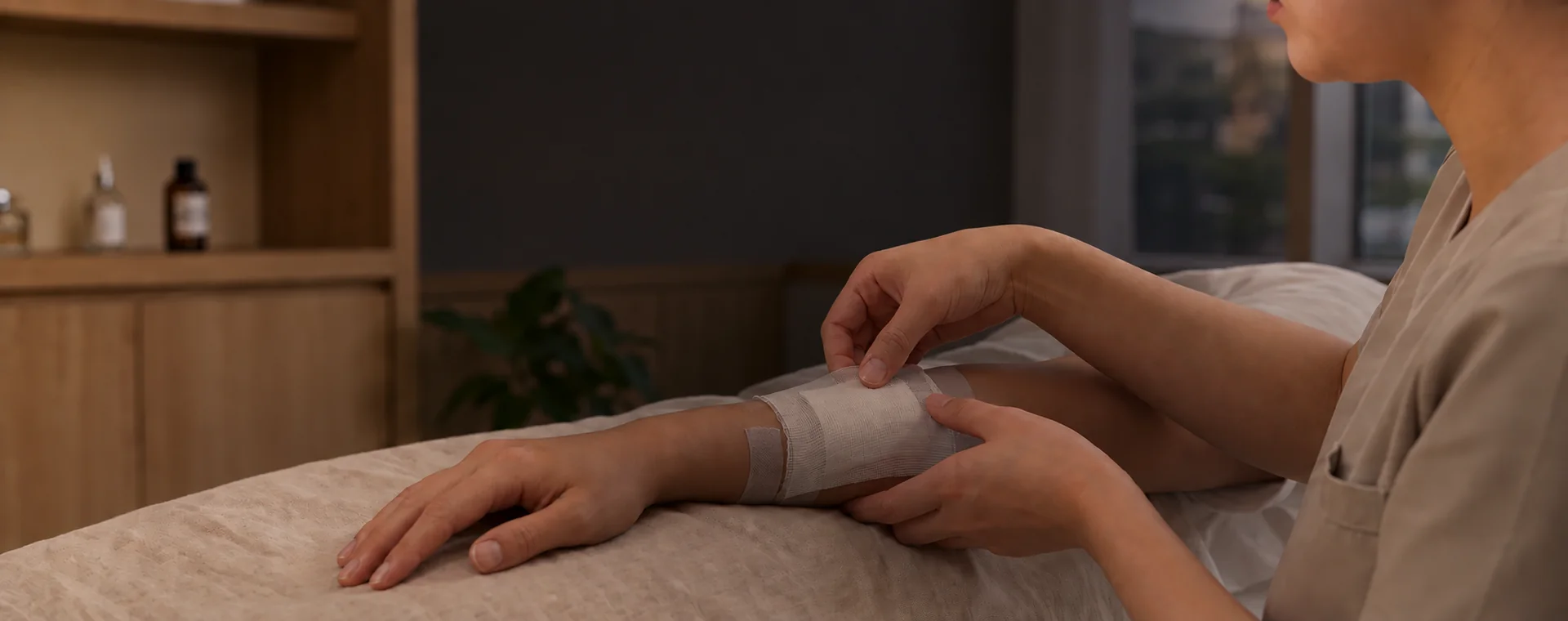
What is a burn scar?
Burn scars are the red marks, pigmentation, thick scars, and contractures that remain on the skin after a burn wound heals. MedlinePlus explains that burns can leave permanent scars, and the World Health Organization notes that burn survivors may experience lasting physical disability, scarring, pain, and limitations in activity.
This article covers the scar that remains after the wound has healed, not first aid immediately after a burn. First aid and emergency room criteria are covered separately in the burn treatment article.
Why do burn scars remain?
Burn scars are more likely the deeper the damage and the longer the wound takes to heal. Myongji Best Plastic Surgery Clinic explains that, depending on the depth of damage, a burn can lead to blisters, discharge, pigmentation, scarring, and contracture, and a burn over a joint can lead to a contracture that limits movement.
Depth and extent of damage
The deeper a burn reaches into the dermis, the more likely thick scars and color changes remain.
Time taken to heal
The UK NHS notes that small burns can take around 2 weeks to heal; for deeper burns that take longer, scar care becomes more important.
Location
Burns on the hands, fingers, and around joints can leave scars that pull and affect movement after healing.
Inflammation or infection during healing
If infection or inflammation is prolonged during healing, the scar can remain deep and thick.
What types of burn scar are there?
Where a burn has healed, red marks, brown pigmentation, thick scars, and contractures can remain separately or together. Which change is the main problem determines whether you can wait, should start care now, or need treatment.
| Change | What it looks like | Care point |
|---|---|---|
| Red mark | What it looks likeThe healed area stays pink or red while the skin remains flat | Care pointTends to fade over time; moisturize and protect from the sun |
| Pigmentation | What it looks likeThe healed area turns darker brown than the surrounding skin | Care pointCan darken with sun exposure, so sun protection is important |
| Thick scar | What it looks likeA firm, raised scar with itching or tightness | Care pointDistinguish hypertrophic scar from keloid; consider silicone, pressure, and injections |
| Contracture | What it looks likeThe scar pulls so the joint cannot straighten or bend | Care pointCheck joint movement; consider surgical correction if needed |
How is a burn scar assessed?
A burn scar consultation checks the scar's extent, thickness, color, adhesion and pulling beneath the skin, and joint movement together. A thick scar is classified as a hypertrophic scar that stays within the original burn area or a keloid that grows beyond its edge.
Color and thickness
Distinguish red marks and pigmentation from thick scars.
Adhesion and pulling
Check whether the scar is stuck to the tissue beneath and whether it pulls during movement.
Joint movement
Check whether joints such as the fingers, wrist, elbow, and knee move through their full range.
Time of healing
Check when the burn healed and how the scar has changed since.
When does burn scar care start, and how is it treated?
Burn scar care starts with moisturizing, sun protection, and silicone once the wound has fully closed, and pressure, injections, and laser are added for scars that thicken or pull. The American Academy of Dermatology advises using silicone gel sheets after the wound closes and notes that pressure is used to reduce or prevent a scar, especially while a burn heals, while the UK NHS advises keeping the scar covered in the sun for at least 1 year and using sunscreen with SPF 30 or more.
| Treatment methods | Main role | What to consider |
|---|---|---|
| Moisturizing | Main roleRelieves dryness and itching of healed skin | What to considerStart once the wound has fully closed |
| Sun protection | Main roleReduces darkening of pigmentation | What to considerAt least 1 year, SPF 30 or higher every time you go out |
| Silicone sheets or gel | Main roleManages the environment of a thickening scar | What to considerUse daily for months after the wound closes |
| Pressure therapy | Main roleReduces thickening of the scar while it heals | What to considerMainly used on joints and large burn areas; consistency is important |
| Injection treatment | Main roleReduces the thickness and itching of thick, red scars | What to considerRepeated treatment may be needed |
| Laser treatment | Main roleManages redness, pigmentation, and surface texture | What to considerMode and interval are planned according to the scar's condition |
| Surgical correction | Main roleCorrects contractures that limit joint movement | What to considerConsidered when other treatments do not restore movement |
In the published evidence, a meta-analysis of pressure garment therapy (2009, 6 randomized trials, 316 patients) reported a small decrease in scar height but no difference in global scar scores, and a Cochrane review (2013, 20 trials, 873 people) found that silicone gel sheeting improved scar thickness and color but rated the study quality as poor. A systematic review of fractional CO2 laser (2021) concluded that laser therapy alone yielded statistically significant improvements in burn scar profiles with very few reports of adverse effects. Myongji Best Plastic Surgery Clinic has no published statistics of its own treatment results.
How does Myongji Best Plastic Surgery Clinic treat burn scars?
After a burn heals, Myongji Best Plastic Surgery Clinic in Myeongji-dong, Gangseo-gu, Busan, considers moisturizing, sun protection, silicone-based scar care, and pressure therapy, and reviews laser or injection treatment when needed. For burns on the face, hands, fingers, and around joints in particular, the treatment plan considers both scar appearance and movement, and for scars that need laser, the treatment area is designed after checking depth, adhesion, surface irregularity, pulling, and color change.
- STEP 01
Check the scar and function
Check the color, thickness, and pulling of the healed area and joint movement.
- STEP 02
Explain basic care
Explain moisturizing, sun protection, silicone-based care, and pressure therapy.
- STEP 03
Decide on additional treatment
Determine whether thickening or red scars need laser or injection treatment.
- STEP 04
Plan the treatment
Set the laser mode, area, and interval according to the scar structure.
- STEP 05
Follow up
Track changes in pigmentation, thick scars, and joint movement.
How does a burn scar change over time?
Red marks tend to fade over time, but the UK NHS notes that fading can take 2 years or more. Meanwhile, keep moisturizing and protecting the area from the sun, watch for thickening scars or pulling on joints, and add treatment if they appear.
What to do
After healing, keep moisturizing and applying SPF 30 or higher sunscreen when going out, and follow the silicone and pressure instructions you were given.
What to avoid
Avoid strong sun exposure, scratching or rubbing the scar, and forcibly removing scabs.
Care over joints
For burns on the fingers, wrist, elbow, or knee, move the joint through its full range and check whether the pulling increases.
When should I contact the clinic right away?
If the healed burn area pulls so that a joint cannot fully straighten or bend, get a consultation right away to check for a contracture. Also contact the clinic if the healed area splits open again or develops discharge, pain, or warmth, or if the scar thickens beyond the original burn area or its redness deepens.
The course of a burn scar and its response to treatment vary with the burn's depth, location, extent, and the time since healing, so the medical team confirms the treatment plan after a consultation.
How is the cost of burn scar treatment determined?
The clinic's published non-covered fee list shows scar laser combined with PN (polynucleotide) injection at 100,000 KRW per cm, and does not list separate fees for silicone, pressure, or injection treatment of burn scars. The actual cost depends on the scar's extent, the chosen treatment, and the number of sessions, and non-covered fees are subject to change.
A note from Myongji Best Plastic Surgery Clinic
With burns, scar care begins once the wound has healed. If you are concerned about the color or thickness of the healed area or a joint feels tight, tell us when the burn happened and how it healed, and we will work out together the care and treatment you need now.
Frequently asked questions
When does the red mark from a burn scar go away
The red mark left after a burn heals tends to fade over time, but the UK NHS notes that fading can take 2 years or more. Keep moisturizing and protecting the area from the sun in the meantime, and have it checked if the red mark thickens or starts to pull.
How long do I need sun protection for burn pigmentation
The UK NHS advises keeping the scar covered in the sun for at least 1 year and using sunscreen with SPF 30 or more on it. Because pigmentation on a burn mark can darken with sun exposure, protect it every time you go out from the moment it heals.
When should I start silicone sheets on a burn scar
The American Academy of Dermatology advises using silicone gel sheets after the wound closes and wearing them every day, often for months, to get results. A Cochrane review (2013) noted that silicone sheeting began in 1981 with the treatment of burn scars and rated the evidence for improving thickness and color as still weak.
What should I do if a finger burn scar pulls and the finger will not straighten
MedlinePlus explains that severe burns affecting the joints may result in contractures, leaving the joint with decreased movement and reduced function. If the joint will not fully straighten, do not wait; get a consultation to find out whether pressure and silicone care are enough or surgical correction is needed.
About the clinic behind this article
Myongji Best Plastic Surgery Clinic is a board-certified plastic surgery clinic in Myeongji-dong, Gangseo-gu, Busan. Dr. Hyungseok Noh, board-certified plastic surgeon and medical director, provides care.
- Address
- Units 302–305, Building 1, 3 Myeongji-gukje 2-ro 28beon-gil, Gangseo-gu, Busan
- Main Line
- 051-711-7991
- Clinic Hours
- Weekdays AM 10:00 ~ PM 07:30Saturday AM 10:00 ~ PM 03:00Sundays & Public Holidays Closed
- Treatment guide
- View the burn treatment page
- Booking
- Naver Booking
REFERENCES
References
This article uses the clinic’s published information together with authoritative medical sources.
- Myongji Best Plastic Surgery ClinicBurn treatment guide
Supports: Possibility of pigmentation, scarring, and contracture depending on burn depth; post-recovery moisturizing, sun protection, silicone, pressure, laser, and injection care; consideration of scar appearance and movement on the face, hands, and joints
- Myongji Best Plastic Surgery ClinicScar treatment guide
Supports: Scar assessment items (depth, adhesion, surface irregularity, pulling, color change), laser treatment area design, post-treatment precautions
- Myongji Best Plastic Surgery ClinicNon-covered fee guide
Supports: Per-cm fee for scar laser combined with PN injection
- NHSScars
Supports: Features of contracture scars, how long scars take to fade, covering the scar from the sun for at least 1 year with SPF 30+ sunscreen, moisturizing massage
Feels tight and the area where the scar is may be difficult or painful to move; it usually happens after a burn
- NHSBurns and scalds
Supports: How long small burns take to heal and use of an emollient for dryness and itching while healing
Small burns and scalds can often be treated at home and can take around 2 weeks to heal.
- MedlinePlusBurns
Supports: Burns can leave permanent scars; contractures and reduced function after severe burns over joints
Severe burns that affect the joints may result in contractures, leaving the joint with decreased movement and reduced function.
- World Health OrganizationBurns
Supports: Lasting scarring, disability, pain, and activity limitations after burns and the need for rehabilitation
Survivors may experience lasting physical disability, scarring, pain, limitations in activity, loss of income and psychosocial effects.
- American Academy of DermatologyScars: Diagnosis and treatment
Supports: When and how long to use silicone gel sheets, pressure therapy while a burn heals, and treatment of scars that limit movement
Reduce (or prevent) a scar, especially while a burn heals
- PubMedThe effectiveness of pressure garment therapy for the prevention of abnormal scarring after burn injury
Anzarut A, Olson J, Singh P, Rowe BH, Tredget EE. The effectiveness of pressure garment therapy for the prevention of abnormal scarring after burn injury: a meta-analysis. J Plast Reconstr Aesthet Surg. 2009;62(1):77-84. doi:10.1016/j.bjps.2007.10.052. PMID 18249046
Supports: Reduction in scar height with pressure garment therapy after burns and no difference in global scar scores (6 randomized trials, 316 patients)
PGT does not appear to alter global scar scores. It does appear to improve scar height, although this difference is small and of questionable clinical importance.
- PubMedFractional CO2 laser treatment for burn scar improvement: A systematic review and meta-analysis
Choi KJ, Williams EA, Pham CH, et al. Fractional CO2 laser treatment for burn scar improvement: A systematic review and meta-analysis. Burns. 2021;47(2):259-269. doi:10.1016/j.burns.2020.10.026. PMID 33288326
Supports: Burn scar improvement with fractional CO2 laser alone and reports of adverse effects
we conducted a systematic review and meta-analysis to determine the efficacy of fractional CO2 lasers in treating burn scars, and found that laser therapy alone yielded statistically significant improvements in scar profiles.
- PubMedSilicone gel sheeting for preventing and treating hypertrophic and keloid scars
O'Brien L, Jones DJ. Silicone gel sheeting for preventing and treating hypertrophic and keloid scars. Cochrane Database Syst Rev. 2013;2013(9):CD003826. doi:10.1002/14651858.CD003826.pub3. PMID 24030657
Supports: Origin of silicone gel sheeting (burn scars, 1981), improvement in thickness and color, and the low level of evidence (20 trials, 873 people)
The use of silicone gel sheeting to prevent and treat hypertrophic scarring is still relatively new and started in 1981 with treatment of burn scars.
Published 2026.10.23Last updated 2026.10.23