
Acne
Acne is a chronic inflammatory condition of the oil glands attached to hair follicles. Myongji Best Plastic Surgery Clinic in Myeongji-dong, Busan summarizes its causes and types, why you should not squeeze it, how medication and procedures differ, and when care is needed.
At a glance
- Main symptoms
- Whiteheads and blackheads (comedones), red papules, pus-filled pustules, deep and painful nodules and cysts
- Causes
- Pores clogged with oil and dead skin cells, hormonal changes, bacteria, genetic factors
- Related conditions
- Folliculitis and seborrheic dermatitis (to rule out), polycystic ovary syndrome, acne scars
- Treatment
- Topical and oral medication first; procedures such as extraction, injection and laser are supplementary
- Department
- Plastic surgery
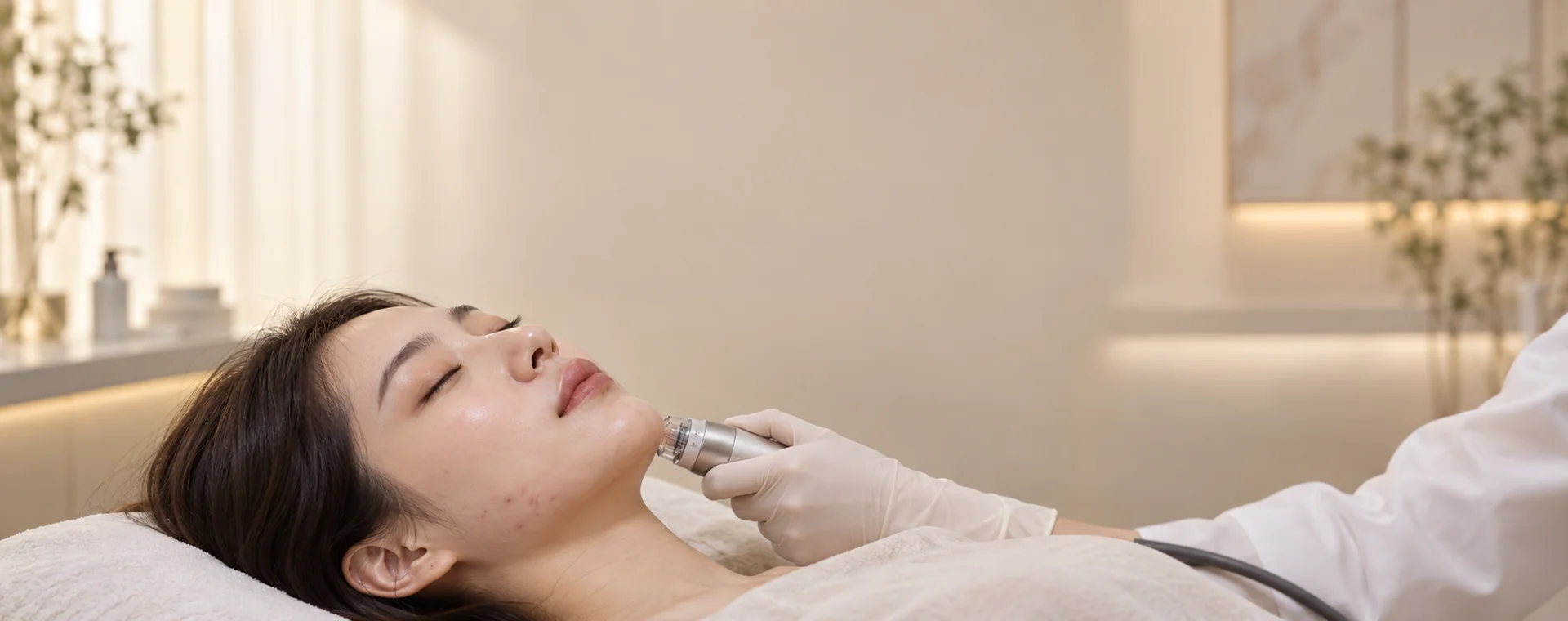
What is acne?
Acne is a chronic inflammatory condition of the oil glands attached to the hair follicles. It usually starts in puberty but also occurs in adults, and it tends to appear on oily areas such as the face, neck, back and chest.
When oil cannot drain out of the skin and is trapped around the follicle, bacteria multiply and cause inflammation. Without early treatment, the risk of redness, color change and scarring increases.
Why does acne develop?
Acne begins when pores become clogged. During puberty, androgens enlarge the oil glands and increase oil, and hormonal changes, bacteria and genetic factors are involved, although the exact cause is not yet known.
Hormones
Teenage acne often results from excess oil stimulated by androgens, while adult acne is more common in women and can flare cyclically before menstruation.
Family history
If a parent or close blood relative had deep, painful acne, you have a higher risk of developing this type of acne.
Aggravating factors
Stress does not cause acne but can worsen it, and lack of sleep, certain foods, and oily makeup and hair products can also make it worse.
What types of acne are there?
Acne starts as comedones, pores clogged by built-up oil; with inflammation it becomes red papules and pus-filled pustules, and when more severe, nodules and cysts deep in the skin. The American Academy of Dermatology explains that nodules and cysts penetrate deep into the skin and often leave permanent scars when they heal.
Whiteheads (closed comedones)
Oil and dead skin cells build up and plug the pore opening, forming a closed, white or flesh-colored bump.
Blackheads (open comedones)
Oil built up inside the pore widens the opening and looks dark.
Papules and pustules
Among red, inflamed pimples, those without pus are papules and those with pus are pustules.
Nodules and cysts
These form deep in the skin and hurt when pressed; firm ones without pus are nodules, and those filled with pus are cysts.
How is acne diagnosed?
Acne is usually diagnosed by examination alone, checking where it appears, such as the face, chest and back, and what types are present. Something that looks like acne may be another condition, and for severe acne hormone tests may be done to rule out an underlying cause.
Type and location
Check which predominates among comedones, inflammatory acne and nodules or cysts, and where they appear. The right treatment differs by type.
Aggravating factors
Check for factors that cause or worsen acne, such as health status, lifestyle habits and the cosmetics you use.
Ruling out similar conditions
Distinguish acne from conditions that look similar, such as folliculitis.
How is acne treated, and how do medication and procedures differ?
The foundation of acne treatment is topical and oral medication, and the American Academy of Dermatology guideline strongly recommends benzoyl peroxide, topical retinoids, topical antibiotics and oral doxycycline. Procedures such as extraction, lasers and peels are added to medication, and the American Academy of Dermatology notes that lasers and light treatments rarely clear acne on their own.
| Treatment | Main role | What to consider |
|---|---|---|
| Topical medication | Main roleTreats clogged pores and inflamed lesions | What to considerMedicines with different actions are often combined |
| Oral medication (antibiotics, hormonal therapy) | Main roleWidespread or highly inflamed acne | What to considerAntibiotic use is limited and combined with topical treatment |
| Isotretinoin | Main roleSevere or scarring acne, or acne that does not respond to standard treatment | What to considerPrescription medicine requiring a doctor's prescription and monitoring |
| Intralesional injection | Main roleLarge, painful acne lesions | What to considerUsed only for a few large lesions |
| Extraction | Main roleRemoves blackheads and whiteheads | What to considerDone in the clinic with sterile instruments |
| Laser, energy-based and peel procedures | Main roleSupplement medication; manage oil and dead skin | What to considerRarely clear acne alone; several sessions needed |
Medication takes at least 6 to 8 weeks to show results, so use it consistently for the set period rather than switching often. Acne medications can have side effects and require a doctor's prescription.
How are acne procedures done at Myongji Best Plastic Surgery Clinic?
Myongji Best Plastic Surgery Clinic in Myeongji-dong, Gangseo-gu, Busan chooses the procedure after checking oil distribution, such as the T-zone and jawline, and the inflammation stage, such as active inflammation, cystic or residual-oil type. It uses Agnes or Gold PTT for recurrent acne and excess oil, and Aqua Peel or LHALA Peel for blackheads and dead-skin care.
Agnes
RF energy is delivered through insulated microneedles matched to the depth of the oil glands. It proceeds as first extraction, RF application and second extraction, and about 3 sessions at monthly intervals are usually recommended.
Gold PTT
Gold particles of about 150nm are applied, 40 to 80kHz ultrasound drives them into the pores, and an 800 to 1200nm laser creates a heat reaction in the oil glands.
Aqua Peel
Suction and solutions clear dead skin, oil and debris from the skin surface and pores, followed by hydrating and soothing care. It is generally done every 2 to 4 weeks.
LHALA Peel
A fourth-generation peel combining LHA, alkali and lipids that refines a thickened outer skin layer, considered once a week or on average every 1 to 2 weeks.
How should I care for my skin during acne treatment and after procedures?
The basics are not squeezing pimples by hand and using prescribed medication consistently for the set period. After a procedure, avoid scrubs, friction and hot environments for the advised period, and keep moisturizing and using sun protection.
Do not squeeze
Squeezing pimples at home can push the contents deep into the skin, increasing inflammation and causing scars and infection.
Lifestyle
Cut down on oily makeup and hair products, and get enough sleep.
After Agnes
Avoid scrubs and exfoliation for a week, and do not pick off scabs.
After Gold PTT
Moisturize well and avoid massage, scrubs, alcohol and smoking for a while.
After Aqua Peel or LHALA Peel
After Aqua Peel, avoid scrubs, peeling products and hot environments for a period; after LHALA Peel, avoid saunas, strenuous exercise, alcohol and strong friction for 2 to 3 days.
Which symptoms mean I should contact the clinic right away?
See a doctor if deep, painful nodules or cysts develop, if acne leaves scars, or if it does not improve after 6 to 8 weeks of treatment. Also contact the clinic if discomfort such as redness, stinging or itching after a procedure persists or worsens.
Treatment methods, duration and responses to procedures vary with the type of acne and skin condition, so the medical team sets the plan after examination.
How much do acne procedures cost?
Myongji Best Plastic Surgery Clinic's published non-covered fee list shows acne extraction care at KRW 66,000 for 1 session and KRW 300,000 for 5, Agnes full face at KRW 330,000 and KRW 850,000 for 3 sessions, Gold PTT at KRW 250,000 for 1 session and KRW 650,000 for 3, Aqua Peel at KRW 77,000 for 1 session and KRW 350,000 for 5, and LHALA Peel at KRW 158,000 (checked October 20, 2026). The total cost of combined procedures is confirmed at consultation, and non-covered fees may change.
A note from Myongji Best Plastic Surgery Clinic
Acne is managed through an ongoing combination of medication, daily care and any needed procedures rather than a single procedure. Tell us about the medicines and cosmetics you use and your past treatments, and we will plan the order of care with you.
Frequently asked questions
Is it okay to pop pimples?
Popping pimples at home can push their contents deeper into the skin, increasing inflammation and risking scars and infection, so it is not recommended. Blackheads and whiteheads can be extracted in the clinic with sterile instruments.
If I get acne procedures, can I skip medication?
Procedures such as lasers and light rarely clear acne on their own, so the American Academy of Dermatology advises using another acne treatment alongside them. Whether you need medication and whether to add a procedure is decided after examining the type and severity of your acne.
How long does acne medication take to work?
Acne medication takes at least 6 to 8 weeks to show an effect, and clearing can take 2 to 3 months or longer. If there is no improvement after that time, treatment is adjusted at a visit.
Causes of adult acne
Adult acne is more common in women and can flare cyclically before menstruation, and oily or pore-clogging cosmetics, stress and lack of sleep can worsen it. It is known to last longer and respond more slowly to treatment than teenage acne.
About the clinic behind this article
Myongji Best Plastic Surgery Clinic is a board-certified plastic surgery clinic in Myeongji-dong, Gangseo-gu, Busan. Dr. Hyungseok Noh, board-certified plastic surgeon and medical director, provides care.
- Address
- Units 302–305, Building 1, 3 Myeongji-gukje 2-ro 28beon-gil, Gangseo-gu, Busan
- Main Line
- 051-711-7991
- Clinic Hours
- Weekdays AM 10:00 ~ PM 07:30Saturday AM 10:00 ~ PM 03:00Sundays & Public Holidays Closed
- Treatment guide
- View the Agnes page
- Booking
- Naver Booking
REFERENCES
References
This article uses the clinic’s published information together with authoritative medical sources.
- Myongji Best Plastic Surgery ClinicAgnes guide
Supports: Oil distribution and inflammation-stage analysis, RF insulated microneedle principle, extraction and RF steps, treatment cycle and recommended sessions, aftercare
For oil gland care, about 3 sessions at monthly intervals are usually recommended.
- Myongji Best Plastic Surgery ClinicGold PTT guide
Supports: Gold particle, ultrasound and laser figures, procedure steps, target concerns, aftercare
Gold PTT is a photothermal treatment using pure gold made into particles of about 150nm.
- Myongji Best Plastic Surgery ClinicAqua Peel guide
Supports: Suction and solution method, blackhead and whitehead care, recommended interval, aftercare precautions
It is generally done every 2 to 4 weeks.
- Myongji Best Plastic Surgery ClinicLHALA Peel guide
Supports: LHA, alkali and lipid composition, recommended interval, precautions for 2 to 3 days after care
It is considered once a week or on average every 1 to 2 weeks.
- Myongji Best Plastic Surgery ClinicNon-covered fee information
Supports: Published fees for acne extraction care, Agnes, Gold PTT, Aqua Peel and LHALA Peel
Acne extraction care KRW 66,000 per session, Agnes full face KRW 330,000, Gold PTT KRW 250,000 per session
- Asan Medical Center Disease EncyclopediaAcne
Supports: Definition of acne, common sites, causes, comedones, papules, pustules, nodules and cysts, diagnosis and treatment categories, adult acne, and the need for early treatment
Acne is a chronic inflammatory disease that occurs in the sebaceous glands attached to the hair follicles that produce hair.
- American Academy of DermatologyAcne: Who gets and causes
Supports: Clogged pores and androgens, family history, stress and lifestyle aggravating factors
Acne develops when pores become clogged.
- American Academy of DermatologyAcne: Signs and symptoms
Supports: Distinguishing whiteheads, blackheads, papules, pustules, nodules and cysts
The main difference between an acne nodule and an acne cyst is that a cyst contains pus.
- American Academy of DermatologyHow to treat different types of acne
Supports: Nodules and cysts readily leave scars and need medical care
These acne blemishes penetrate deep into the skin, and often cause permanent acne scars when they heal.
- American Academy of DermatologyAcne: Diagnosis and treatment
Supports: Diagnosis by examination, other conditions that resemble acne, time for medication to work, in-office procedures
To see clearing, you need to stick to your treatment plan and understand that it takes at least 6 to 8 weeks before you start to see fewer breakouts.
- American Academy of DermatologyLasers and lights: How well do they treat acne?
Supports: Limits of laser and light treatment alone and the need for repeated sessions
Rarely can these treatments alone clear acne.
- American Academy of DermatologyPimple popping: Why only a dermatologist should do it
Supports: Scar and infection risk of popping pimples at home, and in-office extraction
If you push some of the contents inside the pimple deeper into the skin, which often happens, you increase inflammation.
- American Academy of Dermatology9 things to try when acne won’t clear
Supports: Time needed for acne to clear and when to see a doctor
It can take two to three months or longer to see clearing.
- PubMedGuidelines of care for the management of acne vulgaris
Reynolds RV, Yeung H, Cheng CE, et al. Guidelines of care for the management of acne vulgaris. J Am Acad Dermatol. 2024;90(5):1006.e1-1006.e30. doi:10.1016/j.jaad.2023.12.017. PMID: 38300170
Supports: Strongly recommended medications in the American Academy of Dermatology acne guideline, indications for isotretinoin, limiting systemic antibiotics and intralesional injection
Strong recommendations are made for benzoyl peroxide, topical retinoids, topical antibiotics, and oral doxycycline.
Published 2026.10.20Last updated 2026.10.20